
Autism Assessment in Sydney: The Process, What to Prepare, and What You Receive
If you are considering an autism assessment in Sydney, you are probably carrying a mix of questions, uncertainty and hope. You may be wondering whether your child’s differences point toward autism, whether you have recognised something in yourself later in life, or whether a formal assessment would actually help.
At Home Psychology, we provide autism assessments for children, adolescents and adults. Our goal is not to reduce anyone to a label. It is to understand the person more clearly, identify their strengths, and provide practical guidance about support, next steps and recommendations.
This guide explains what an autism assessment usually involves, how to prepare, and what you can expect to receive at the end.
Questions about the process? Jump to FAQs >
What is an autism assessment?
An autism assessment is a comprehensive evaluation that looks at social communication, behaviour, sensory experiences, developmental history and day-to-day functioning. It usually includes interviews, questionnaires, behavioural observation and standardised assessment tools.
A good assessment is not rushed. It is thoughtful, evidence-informed and tailored to the individual. For some families, that means understanding a child’s profile more clearly. For teens and adults, it can mean finally making sense of patterns that have been present for years.
When might an autism assessment be worth considering?
People seek autism assessments for many different reasons. Sometimes concerns have been present for a long time. Sometimes they become clearer when social, school, work or relationship demands increase.
You might consider an autism assessment if you have noticed things such as:
Differences in social communication or connection
Sensory sensitivities to sound, textures, food, light or routine changes
Intense or highly focused interests
Repetitive behaviours or strong preferences for sameness
Social exhaustion, masking or burnout
Ongoing questions about whether autism may help explain someone’s experiences
Autism can present differently across children, teenagers and adults. It can also present differently in girls and women, who may mask more effectively and therefore be identified later.

What does the autism assessment process usually involve?
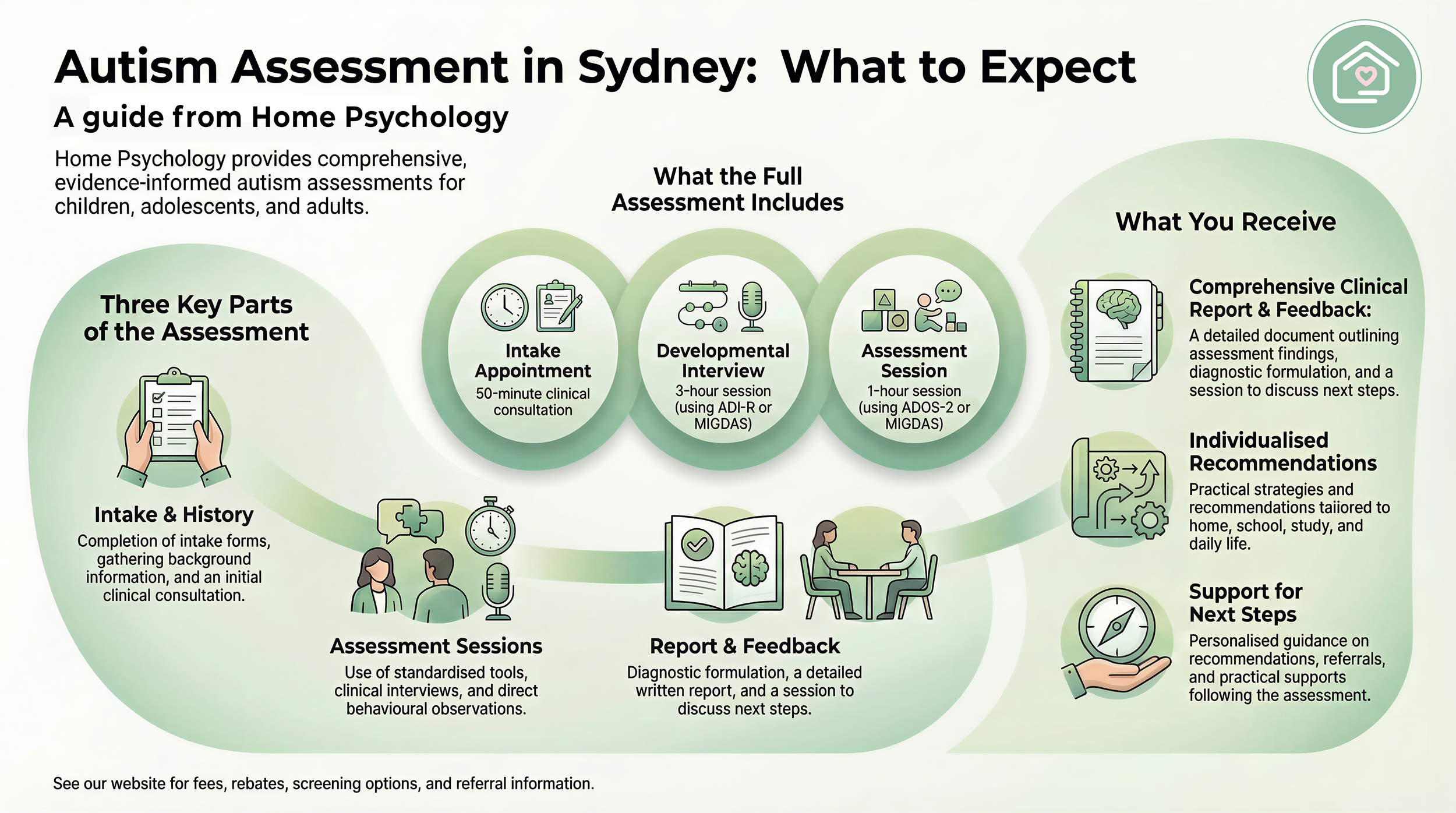
While every clinic has its own process, a comprehensive autism assessment in Sydney often includes several parts rather than a single appointment.
1. An initial consultation
This is usually the starting point. We talk through your concerns, relevant history, current challenges, strengths and goals for assessment. This helps determine whether a full autism assessment is the right next step.
For many people, this first step is also reassuring. It gives you space to ask questions, understand the process, and talk through whether assessment feels appropriate.
2. A detailed developmental interview
For children and adolescents, this often includes a parent or caregiver interview focused on early development, communication, relationships, behaviour, sensory experiences and daily functioning. For adults, it may include a detailed clinical interview about childhood history, current experiences, coping strategies and masking.
This part matters because autism assessment is not based on one moment in a room. It looks at patterns across time.
3. Standardised assessment tools
Autism assessments commonly include gold-standard tools such as the ADOS-2 and ADI-R, depending on the person’s age, presentation and needs. These tools help structure the assessment and support clinical decision-making.
They are important, but they are not the whole picture. A thoughtful autism assessment does not rely on one tool alone. It considers interviews, observations, history and clinical expertise together.
4. Observation and broader assessment
A clinician may observe how the person communicates, responds socially, manages change, engages with activities, and presents sensory or behavioural differences. In some cases, cognitive or learning assessment may also be recommended to build a fuller understanding of strengths and support needs.
5. Integration and feedback
Once all parts of the assessment are complete, the clinician reviews and integrates the information. If diagnostic criteria are met, the report explains why. If they are not, the report should still provide clarity about what may be contributing to the concerns and what supports may be helpful.
What should you prepare before an autism assessment?
You do not need to prepare perfectly. You do not need to “perform” autism. And you do not need to arrive with every answer. Still, a little preparation can make the process smoother and more helpful.
Gather relevant documents
Bring along any previous reports that may help build the picture, such as:
School reports or teacher observations
Speech pathology or occupational therapy reports
Paediatric, GP or allied health letters
Previous cognitive, learning or behavioural assessments
Write down key observations
It can help to note down the things you have been seeing and wondering about. For children, that may include communication patterns, friendships, play, routines, sensory preferences, meltdowns, shut-downs or transitions. For adults, it may include masking, burnout, workplace challenges, sensory overload, friendship patterns or long-standing feelings of being different.
Note developmental history
If the assessment is for a child, it can be useful to think back over early milestones, speech and language development, play, schooling and any concerns raised over time.
Bring your questions
Many people want to know how long the process takes, whether Medicare rebates apply, whether the report can support NDIS applications, or what happens if autism is not diagnosed. Write those questions down and bring them with you.
What does the process feel like?
This part is often left out of blog posts, but it matters.
A well-run autism assessment should feel respectful, collaborative and clear. It should not feel like you are being judged. For children, the aim is to create a space where they can engage as naturally as possible. For adults, the process should feel thoughtful and validating, not cold or reductionistic.
Assessment can still be emotional. For some people, it brings relief. For others, it stirs grief, confusion or exhaustion before clarity arrives. That is normal. Part of good assessment practice is making room for that.
What do you receive after an autism assessment?
At the end of a comprehensive autism assessment, you should receive a detailed written report and a feedback session.
The report typically explains:
the reason for referral
the background and developmental history considered
the assessment tools used
the clinician’s observations
whether diagnostic criteria were met
the person’s strengths and support needs
practical recommendations for home, school, work or daily life
That recommendations section is one of the most valuable parts of the process. A good report should not just answer “yes” or “no.” It should help you understand what to do next.
Recommendations may include school supports, workplace adjustments, emotional support, speech therapy, occupational therapy, further assessment, or strategies for sensory regulation, communication and daily functioning.
You do not need to have everything figured out before reaching out
If you are searching for an autism assessment in Sydney, you do not need to have everything figured out before reaching out. An initial conversation can help you decide whether assessment is the right next step.
At Home Psychology in Caringbah, we provide autism assessments for children, adolescents and adults, with a warm, client-centred approach and practical recommendations designed to support life beyond the report.
Disclaimer
This article is general information only and does not constitute individual clinical advice. For advice specific to your situation, please contact a qualified psychologist.
Frequently Asked Questions
-
A comprehensive autism assessment usually takes place across multiple appointments rather than one brief session. The exact timeframe depends on the person’s age, presentation and whether additional cognitive or learning assessment is needed.
The Psychologist will outline the process in the initial session.
-
At Home Psychology, a full autism assessment is currently $2,200.00. All psychology assessments begin with a 50-minute intake appointment at $232.99, and there is no obligation to proceed beyond that first step.
The autism assessment fee includes background information gathering, a 3-hour parent developmental interview using ADI-R or MIGDAS, a 1-hour assessment session using ADOS-2 or MIGDAS, an adaptive questionnaire if required, diagnostic formulation, an extensive written report with individualised recommendations, a phone call to the school or other allied health professionals if needed, and a 50-minute parent feedback session.
As fees can change, it is worth checking the Fees and Rebates page for the latest pricing.
-
Home Psychology also offers screening assessments for $780.00 to help determine whether it is worthwhile proceeding with a full ADHD or autism assessment.
A screening assessment is not sufficient to provide a diagnosis, so it is best understood as a decision-making step rather than a diagnostic one.
-
Home Psychology provides autism assessments for children, adolescents and adults.
-
An autism assessment is a comprehensive evaluation designed to identify the presence and nature of autism-related differences.
The assessment typically includes a combination of standardised tests, interviews with the individual and caregivers, and behavioural observations, with a focus on social communication, restricted and repetitive behaviours, and sensory sensitivities. Assessment tools may include ADOS-2 and ADI-R, depending on the person’s age, presentation and needs.
-
If you are seeking an autism diagnosis or intervention support, a paediatrician can refer under a Complex Neurodevelopmental Disorders plan.
-
An autism assessment report can help support an NDIS application or planning process, but it does not automatically guarantee funding.
Home Psychology provides services to NDIS participants who are self-managed or plan managed. Eligibility and funding decisions are still made by the NDIS according to its own criteria.
-
At the end of the assessment, you receive diagnostic formulation, an extensive written report with individualised recommendations, and a 50-minute feedback session.
That means the outcome is not just a yes-or-no answer. It is a clearer understanding of the person’s profile, along with practical recommendations for next steps.
Final thoughts
A thoughtful autism assessment can provide far more than a diagnosis. It can offer language, context, reassurance and a clearer path forward.
Whether you are seeking an autism assessment in Sydney for your child, your teenager or yourself, Home Psychology can help you understand the process and decide on the next right step. If you would like to learn more about assessment, fees, Medicare pathways or current availability, please feel free to get in touch with our team.