

ADHD Assessment in Sydney: What It Involves, What to Expect, and Next Steps
For many adults, the idea of an ADHD assessment begins as a quiet suspicion rather than a clear decision. Life may have long felt harder to organise than it seems to for other people, with missed deadlines, mental clutter, constant overwhelm or a sense of always working harder just to stay on top of ordinary demands. For parents, the path can look different but feel just as uncertain: a growing awareness that a child or teenager is struggling in ways that deserve a closer look. In both cases, what often brings people to assessment is not a search for a label, but a search for clarity.
At Home Psychology, we offer ADHD assessments for children, adolescents and adults. The aim is to build a clearer understanding of how someone is functioning, where their difficulties are showing up, and what kinds of support or recommendations may be helpful going forward.
Below, we walk through how an ADHD assessment may unfold, what can be helpful to bring or think about beforehand, and what you may receive once the assessment is complete.
Questions about the process? Jump to FAQs >

What is an ADHD assessment?
An ADHD assessment is a detailed evaluation of patterns relating to attention, concentration, impulsivity, activity level, executive functioning and everyday life. It looks beyond whether someone is simply distracted, disorganised or forgetful, and considers how these patterns show up across settings such as home, school, work and relationships.
A thorough assessment takes time and care. Rather than relying on one brief impression, it draws on multiple sources of information, which may include interviews, developmental history, questionnaires and cognitive assessment, so the clinician can form a balanced view of the person’s presentation.
For some families, an ADHD assessment helps explain why a child is struggling despite obvious strengths. For teenagers, it can provide clarity during a stage of life that is already full of change and pressure. For adults, it can mean finally making sense of difficulties that have been present for years, even if they were never recognised properly at the time.
When might an ADHD assessment be worth considering?
People seek an ADHD assessment for many different reasons. Sometimes the concerns have been present for a long time. Sometimes they become more noticeable when school expectations increase, work becomes harder to manage, or daily responsibilities start to pile up.
You might consider an ADHD assessment if you have noticed ongoing difficulties such as trouble sustaining attention, forgetfulness, disorganisation, impulsivity, restlessness, emotional frustration, difficulty following through on tasks, or a sense that someone is capable but consistently finding everyday demands harder to manage than expected.
ADHD can present differently across children, adolescents and adults. It also does not always look like the stereotype many people have in mind. In children, concerns may show up through classroom difficulties, incomplete work, trouble listening, high activity levels, strong reactions, or challenges with routines and transitions. Some children may seem constantly on the go. Others may appear quieter, but still struggle significantly with attention, distraction or internal restlessness.
In adolescents, ADHD may become more obvious as academic pressure, independence and social expectations increase. A teenager may seem intelligent and hard-working, yet repeatedly miss deadlines, lose track of tasks, struggle with planning, or become overwhelmed by the demands placed on them.
In adults, ADHD can look like chronic disorganisation, time management difficulties, missed deadlines, unfinished tasks, forgetfulness, mental clutter, overwhelm or burnout. Some adults only begin to explore ADHD after recognising similar patterns in their child. Others reach a point where the coping strategies they have relied on for years simply stop being enough.
What does the ADHD assessment process usually involve?
An ADHD assessment is rarely based on one short meeting alone. In most cases, it involves a number of parts that help the clinician understand not just the current concerns, but the broader pattern over time.
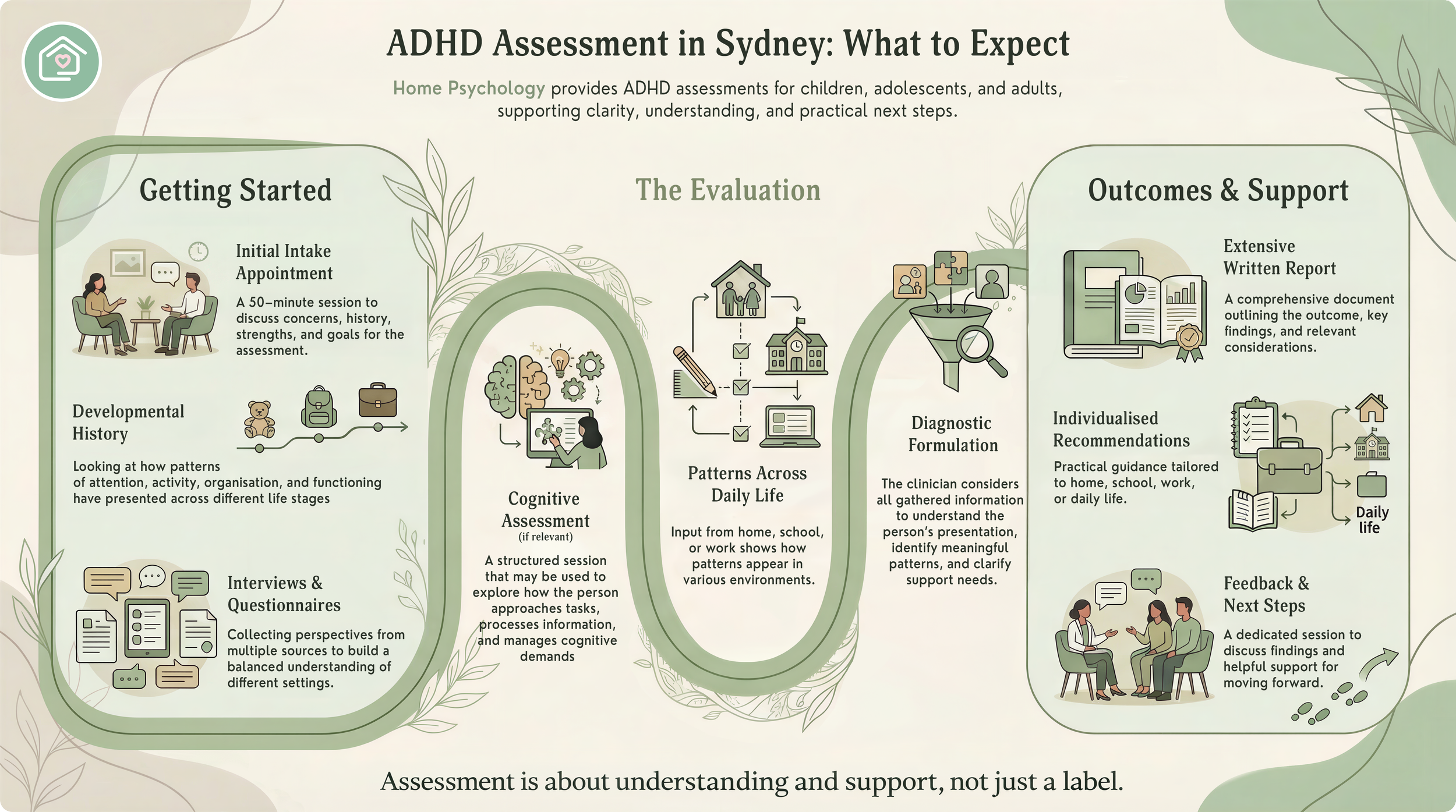
At Home Psychology, the process begins with an initial 50-minute intake appointment. This is an opportunity to talk through concerns, relevant history, current challenges, strengths and the reasons you are seeking assessment. It also gives people time to ask practical questions, get a sense of what the assessment may involve, and decide whether proceeding feels appropriate.
From there, the assessment may include collecting background information and developmental history so that the clinician can understand how the difficulties have presented across different stages of life. For children and adolescents, this often means parent input about early development, behaviour, attention, learning and day-to-day functioning. For adults, developmental history still matters and may involve a structured clinical interview such as the DIVA (Diagnostic Interview for ADHD in Adults), which is designed to assess ADHD symptoms and their impact across both childhood and adulthood.
The process may include a 1 to 2 hour cognitive assessment session, with tools such as the WISC-V. This helps build a broader picture of how the person approaches tasks, processes information and manages cognitive demands. Most individuals complete this component within one session, though an additional session may be needed if a slower pace or more frequent breaks are required.
Another part of the assessment may involve questionnaires completed by school, parents and self, using tools such as the Conners-4. This can be useful because ADHD often affects more than one area of life, and different perspectives may help show how difficulties are presenting across settings rather than in one context alone.
Once the relevant information has been gathered, the clinician brings it together into a diagnostic formulation. This may include an extensive written report with individualised recommendations. The process may also include a feedback session with parents, as well as contact with the school or other allied health professionals if required.
What should you prepare before an ADHD assessment?
There is no need to come in having organised everything flawlessly, and no expectation that you should somehow demonstrate ADHD in the room. The assessment is there to help make sense of patterns, not to test how well you can explain them on the spot. Even so, a little preparation can make the appointment feel more straightforward and useful.
It can be helpful to gather any documents that may add context. Depending on the person’s age and circumstances, that might include school reports, teacher observations, previous psychology or allied health reports, paediatric or GP letters, or earlier cognitive or learning assessments.
It is also worth jotting down the main concerns that have prompted you to seek assessment. For children, that may include attention difficulties, behaviour at home, homework patterns, transitions, emotional regulation or classroom concerns. For adolescents, it may include disorganisation, study stress, forgetfulness, frustration, motivation or feeling constantly overwhelmed. For adults, it may include workplace difficulties, chronic lateness, unfinished tasks, burnout, poor time management or a long-standing sense that daily life takes more effort than it seems to for other people.
If the assessment is for a child, it may help to think back over early development and any patterns that have been noticeable across time. If the assessment is for yourself, it can be useful to reflect on whether similar difficulties have been present since earlier life, even if they were not recognised then.
Questions are worth bringing too. People often want to know how the appointments are structured, what happens if ADHD is or is not identified, what sort of recommendations may be included, and what the next steps could look like afterwards. Having those questions written down can make the process feel less overwhelming.
What does the process feel like?
People are often given information about the practical steps of assessment, but not much about what the experience is actually like. That part matters too.
A well-conducted ADHD assessment should feel organised, respectful and collaborative. It should create room for honesty rather than making someone feel scrutinised for the ways they are struggling. For children, that means supporting them to participate as comfortably as possible. For adolescents and adults, it should feel steady, thoughtful and human, rather than detached or overly clinical.
The process can still bring up a lot emotionally. Some people feel relieved that persistent difficulties are finally being explored properly. Others feel unsettled, worn out or unsure while they wait for answers. Parents may feel a mix of validation and worry. Adults may find themselves looking back on earlier years with both hope and sadness.
All of that can be part of the experience. Good assessment practice makes space for those reactions rather than treating them as beside the point.
What happens after an ADHD assessment?
At the end of a comprehensive ADHD assessment, you should receive clear feedback about the outcome as well as practical guidance about next steps.
This may include an extensive written report with individualised recommendations, along with a feedback session to talk through the findings. A good report should not simply list symptoms or deliver a yes-or-no answer. It should help explain what was considered, what patterns were identified, and what supports may be helpful moving forward. That may include recommendations for home, school, work or daily life. Depending on the person and the outcome, next steps may involve school-based supports, further medical review, therapy, parent strategies, environmental adjustments, or practical approaches to attention, organisation and emotional regulation.
Even where ADHD is not diagnosed, a good assessment can still provide meaningful clarity. It may identify other factors contributing to the concerns and help guide the next stage of support. In that sense, a thoughtful assessment still has value even when the answer is not the one originally expected.
Assessment is about understanding and support, not just a label
It is common for people to feel ambivalent about assessment because of what a diagnosis might seem to mean. Some worry that it will flatten the person into a category or define them too narrowly. A good ADHD assessment should do the opposite. It should help make sense of why certain demands may have been difficult to manage, where the person’s strengths are, and what kinds of supports or adjustments may actually make everyday life easier. For children, this may shape support at home and school. For adolescents, it can offer context during a period when expectations are rising quickly. For adults, it can bring language to experiences that may have felt confusing, frustrating or unfairly hard for a long time.
Done well, assessment is not only about naming a condition. It is about giving people a clearer understanding of themselves or their child, and helping guide what comes next.
Taking the next step does not require certainty
People often delay reaching out because they feel they should be more certain first. In reality, you do not need complete confidence that ADHD is the answer before starting a conversation. Part of the purpose of assessment is to help clarify exactly that.
At Home Psychology in Caringbah, we provide ADHD assessments for children, adolescents and adults, with a warm, client-centred approach and practical recommendations designed to support life beyond the report. Whether the assessment is for a child, a teenager, or an adult in Sydney, the aim is the same: greater clarity, a better understanding of what is going on, and a more informed sense of what may help next.
For current assessment pricing, please visit our Fees and Rebates page. If you would like to learn more or take a first step, please feel free to get in touch with our team.
Disclaimer
This article is general information only and does not constitute individual clinical advice. For advice specific to your situation, please contact a qualified psychologist.
Frequently Asked Questions
-
An ADHD assessment may be worth considering if there are ongoing difficulties with attention, focus, impulsivity, organisation, emotional regulation or daily functioning across settings such as home, school or work. An assessment can help clarify whether ADHD may be contributing to these difficulties and what support may help.
-
Yes. ADHD assessments are not only for children. Many adults seek assessment after years of struggling with attention, organisation, time management, overwhelm or burnout, often without fully understanding why.
-
A comprehensive ADHD assessment often includes an initial intake appointment, developmental and background history, cognitive assessment, questionnaires, clinical formulation, a written report and a feedback session. The exact process may vary depending on the individual.
-
The exact timeframe may vary depending on the individual and the information needed. Based on Home Psychology’s website, the process may involve an initial 50-minute intake appointment, a 1 to 2 hour cognitive assessment session, and a feedback session, with additional time sometimes needed for questionnaires, background information gathering, report writing, or a slower pace if more breaks are required.
-
Sometimes. For children, school input can be very helpful because it shows how attention, regulation and functioning present in another important setting. Home Psychology notes that questionnaires may be completed by school, parents and self where relevant.
-
You may receive a detailed written report, feedback about the outcome, and practical recommendations tailored to home, school, work or daily life. A good assessment should help clarify both findings and next steps.
-
That does not mean the assessment was pointless. A well-conducted assessment can still provide clarity about what may be contributing to the concerns and what kinds of support, strategies or further assessment may be helpful.
-
For current assessment pricing, please visit Home Psychology’s Fees and Rebates page.